
Topkapı Palace
The sultans’ palace on Sarayburnu: courtyards, the Imperial Council, the treasury and the terraces over the water. Dated entry, sold online on its own site.
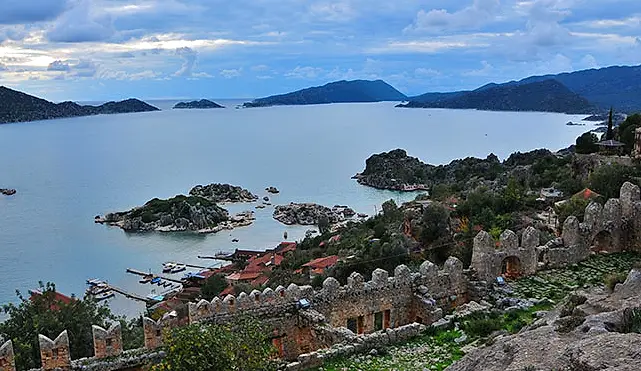
The ancient site beneath the village of Kaleköy, with a medieval castle, a tiny rock-cut theatre and Lycian tombs, in a setting by the sea.
The village of Kaleköy is built on top of the ancient city of Simena. Inscriptions trace its history back to the fourth century BC, and the castle was used in the Middle Ages.
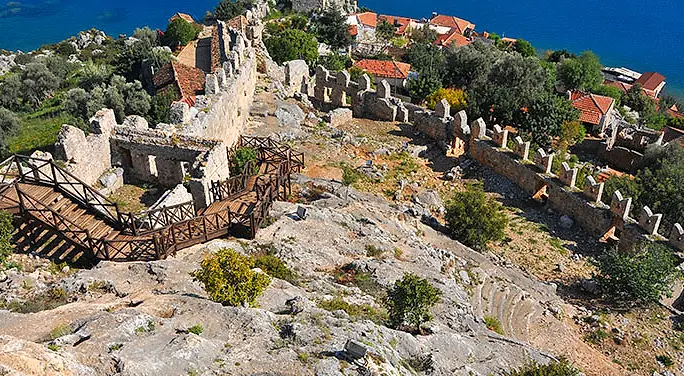
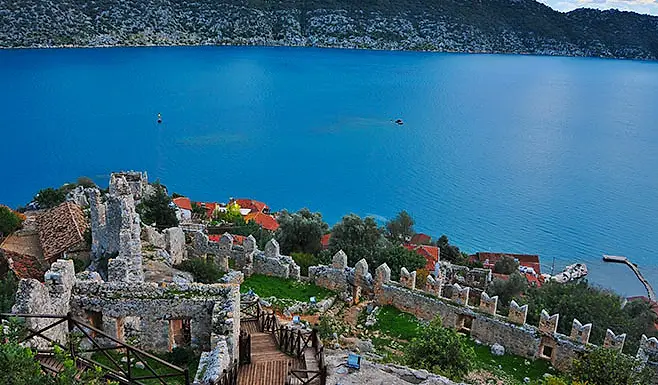
Inside the medieval walls of the inner fortress stood a temple, of which only a few blocks remain, and a connected stoa. Also within the fortress is a theatre cut into the natural rock, with seven rows of seats for about 300 people, the smallest theatre among the Lycian cities. A Roman wall of neat blocks stands above a rock tomb, and on top of it a later fortification with battlements, so three periods can be seen at once.
On the shore you can find the ruined bath, whose inscription records that it was a gift to the Emperor Titus, and many tombs, including two house-type ones. Together the fortress, theatre and tombs make a small but memorable site.
According to the Ministry’s listing it opens at 08:00 and closes at 20:00 (last entry 19:30). Open every day.
No. This site sells no tickets. Topkapı Palace, the Basilica Cistern, Hagia Sophia and Dolmabahçe Palace are sold on our sister sites; for Simena Archaeological Site, buy at the ticket office or on the Ministry’s official e-ticket system.
Simena Archaeological Site is in Antalya, Türkiye — Üçağız Mah., Kale Köyü Mevkii.
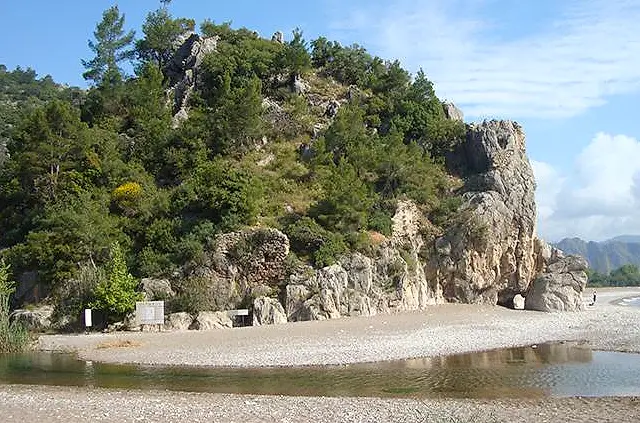
A Lycian coast city hidden in a wooded valley beside a beach, once a pirates' haven, with a theatre, a Byzantine church and the eternal flames of Chimaera nearby.
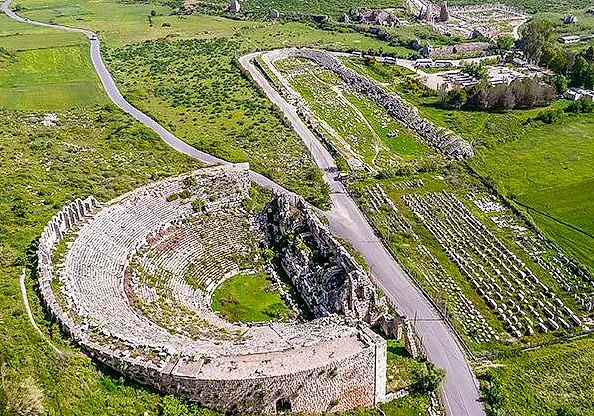
One of Turkey's best-preserved Roman cities, on a plain east of Antalya, with a Hellenistic gate, colonnaded streets, theatre and stadium.
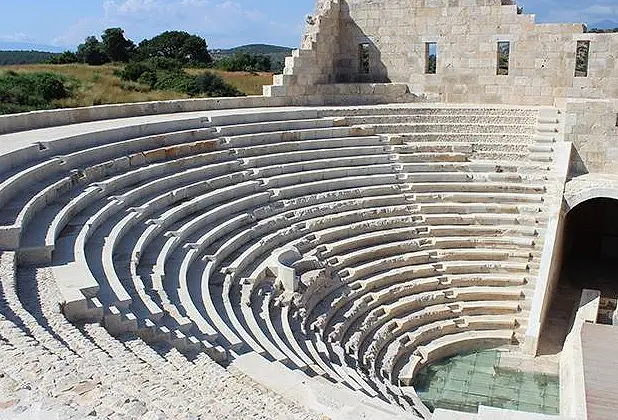
Capital of the Lycian League and birthplace of St. Nicholas, on a coast beside one of Turkey's longest beaches, with a lighthouse, a parliament house and an oracle tradition.
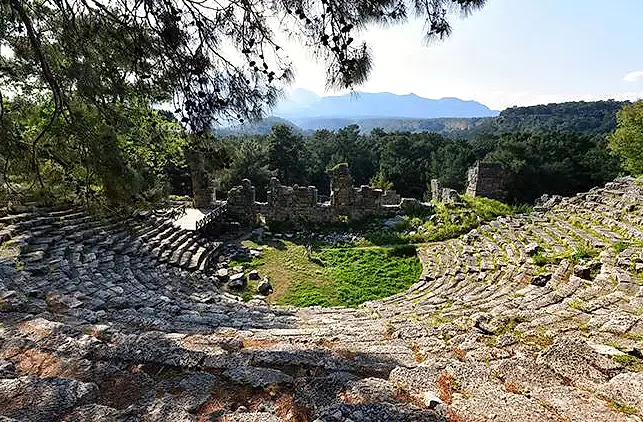
A trading city on a pine-covered peninsula with three harbours, visited by Emperor Hadrian and Alexander the Great, and known for its water-supply engineering.
Four Istanbul landmarks, each sold on its own site by the agency behind this guide — dated entry and free cancellation up to 24 hours.
The sultans’ palace on Sarayburnu: courtyards, the Imperial Council, the treasury and the terraces over the water. Dated entry, sold online on its own site.
Justinian’s great underground reservoir: 336 columns in still water and the two Medusa heads. Fast-track entry with a digital audio guide.
Justinian’s cathedral, the sultans’ mosque and a working mosque again today. The ticket admits you to the upper visitor gallery.
A nineteenth-century palace on the water’s edge: the Selamlık, the Ceremonial Hall under its chandelier, the crystal staircase and the Harem.


